

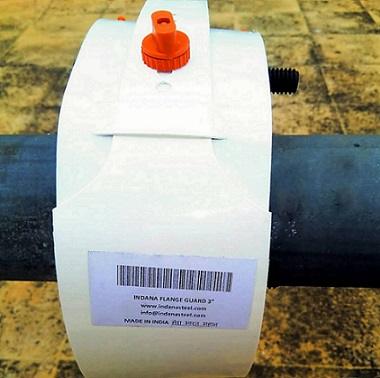
Industrial safety literature rarely examines the physics beneath the products it celebrates. Brave flange guards, typically marketed as simple spray shields, are in fact precision-engineered barriers whose performance hinges on fluid dynamics, material science, and thermodynamics. This analysis strips away the marketing veneer to examine what actually determines whether a flange guard succeeds or fails in high-pressure service.
The Conventional Wisdom Problem
Most procurement teams treat flange guards as commodity accessories: fabricate a sleeve, strap it around the joint, and move on. This assumption is dangerously outdated. Modern process systems operating above 40 bar routinely defeat guards designed for low-pressure steam lines, and the failure mode is rarely the strap or the fabric itself. It is the misunderstood interaction between the guard’s geometry and the trajectory of a pressurized jet.
Brave flange guards distinguish themselves through engineered venting geometry and multi-layer construction rather than generic PVC wraps. Yet even premium products are frequently misapplied because specifiers evaluate them on temperature rating alone, ignoring the more consequential variables of jet impingement angle and chemical compatibility under sustained saturation.
What the 2024 Data Actually Reveals
Recent industry reporting indicates that flange-related releases account for a disproportionate share of reported process safety incidents in petrochemical facilities, with a substantial majority occurring at joints operating above ambient temperature and pressure. More tellingly, post-incident audits consistently find that a large fraction of installed guards were either incorrectly sized or constructed from materials incompatible with the contained fluid.
These statistics reframe the entire value proposition. The problem is not guard absence but guard inadequacy. A spray shield that delaminates under caustic exposure or degrades at 150°C provides psychological comfort while offering negligible protection. The data suggests that specification errors, not product failures, drive most negative outcomes, which means the highest-return investment is engineering review rather than hardware volume.
Material Science Behind the Shield
Why Layer Count Matters
A pressurized pinhole leak can exit a flange gap at velocities exceeding 100 meters per second. Single-layer guards absorb this energy poorly, transmitting impact stress directly to the fastening system. Brave flange guard s address this through laminated construction that distributes impingement energy across multiple interfaces, converting a concentrated jet into a diffuse seep that drains safely.
- Outer layer: abrasion and UV resistance for outdoor service
- Intermediate layer: energy dissipation and puncture resistance
- Inner layer: chemical barrier matched to the process fluid
- Vent geometry: directional drainage away from personnel zones
Installation Variables That Determine Performance
Even flawless hardware fails when installed with incorrect standoff distance. A guard fitted flush against the flange restricts drainage and allows corrosive condensate to pool against the joint, accelerating the very degradation it was purchased to contain. Proper installation maintains an air gap that permits visual inspection while channeling releases downward.
Fastening tension is equally consequential. Over-tightened straps deform the guard’s internal geometry and create stress concentrations; under-tightened straps allow the shield to migrate under vibration. Documented torque values, not installer judgment, should govern every installation.
The Contrarian Case Against Universal Specifications
Industry practice gravitates toward standardized guard specifications applied facility-wide. This approach is administratively convenient and technically indefensible. A steam header at 180°C demands fundamentally different material properties than a sulfuric acid line at ambient temperature, yet both frequently receive identical shields from the same storeroom shelf.
The contrarian position is straightforward: flange guards should be specified per joint, using a documented matrix of fluid, temperature, pressure, and accessibility. Brave flange guards, with their broader material range, make this feasible, but only if engineering owns the selection rather than procurement.
- Map every flanged joint by service conditions
- Assign guard class based on fluid aggressiveness
- Verify chemical compatibility at saturation temperature
- Document installation torque and standoff in maintenance records
Inspection and Lifecycle Reality
Guards are typically installed and forgotten, a pattern that undermines their protective function. UV exposure embrittles polymers, chemical saturation alters flexibility, and thermal cycling induces microcracking. Annual inspection with replacement cycles tied to service severity, not calendar convenience, is the defensible standard.
Facilities that treat guards as inspection points rather than passive accessories report measurably better containment outcomes. The guard becomes a sentinel: condensation staining,